The Art of Stillness: How to Exercise Your Creativity
- Tom McPherson
- Dec 4, 2025
- 4 min read
Updated: Dec 6, 2025

The stillness that once filled daily life has been replaced by movement and distraction. We fill every gap in our attention with something, anything, to keep ourselves occupied.
Yet in losing that space, we may also have lost something essential, one of the key conditions on which creativity depends. Stillness is often the entry point to deeper perception. It is the foundation stone before a new thought forms, the brief moment of emptiness before our imagination is set free. When we remove stillness entirely, we also remove the conditions in which new ideas take shape.
The desire to escape stillness and silence remains strong because these quiet moments reveal our true selves, not just our minds with their thoughts of hope and anxiety, but more fundamentally our inner self, the self that lies behind the mind.
When there is no screen, no sound, no conversation, we meet the true fears and desires of our own thoughts. At first, that inner silence can feel uncomfortable. It can feel like opening a memory box that has been left sealed for a reason. But if we remain with our thoughts and our silence a little longer, if we resist the reflex to reach for a distraction, the mind begins to settle.
What felt like emptiness becomes a form of attention. With practice, we can learn to feel comfortable during these small pockets of stillness and silence. The aim is to silence distractions and, over time, silence our minds.
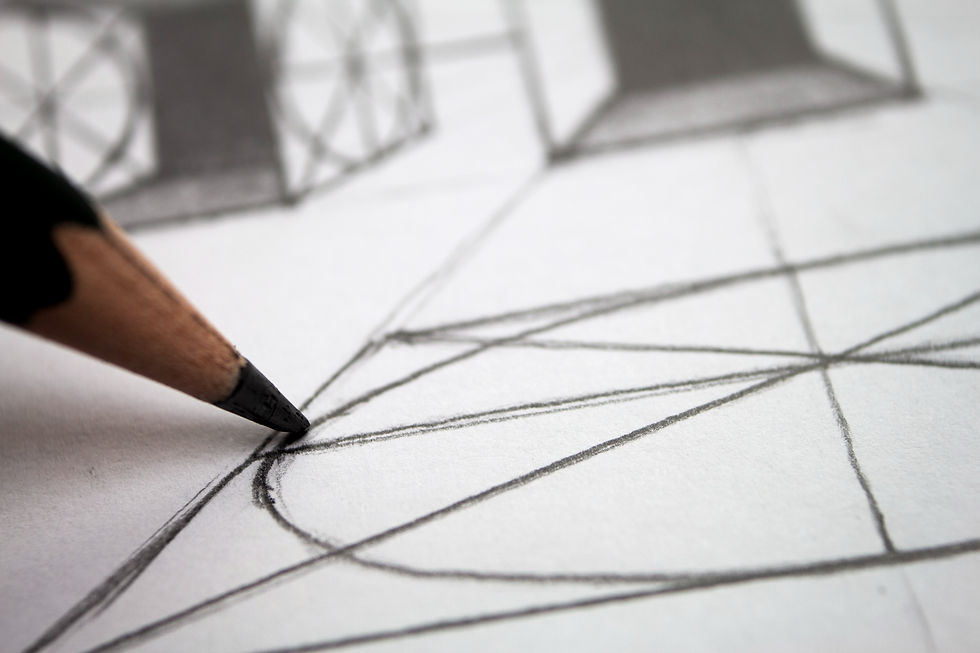
What looks like nothing is often the beginning of something. A visual artist facing a blank sheet of paper knows this experience well. Before the first line appears, there is a slight tension: nothing is happening, yet everything is possible. If you pause before you draw, something deeper begins to take shape. The mind, freed from the need to act instantly, starts to connect with its own inner rhythms. The faint memory of a dream, the echo of an unfinished thought, the observation you barely noticed on your way home, these fragments become the raw material of new creative work.
Inspiration requires you to be willing to not have complete control over what mark you will draw next. There is no way to fully understand inspiration; there are no guarantees. It might quietly leave you or strike like a thunderbolt. If you expect it to stop, you will be more likely to trust its guidance when it possesses you. Never wait for inspiration; work hard at drawing and living, and it will show up when it wants to. Trust the process. Do the work.
Sitting in a moment without filling it with distractions trains a part of the mind that can remain focused amid uncertainty. These capacities, of patience and sustained attention, are the foundations of deep creative work. Most art emerges not from the first spark of inspiration but from the long work of carrying an idea through to completion. Ideas appear quickly, and they are often not as valuable as they seem at first; execution is more important, and that requires stillness, persistence, and the ability to stay with something long after the initial excitement fades.
In moments of stillness, our senses begin to reawaken. We start to truly notice our surroundings. We observe small, overlooked details: the pattern of light through a window, the irregular rhythm of footsteps outside, the way a leaf turns in the breeze. These fragments often serve as the basis for artistic creativity because they are noticed in a moment of presence; they remain vivid and timeless in our memory, long after distractions have faded.
When we stop filling every pause with consumption, our attention begins to regain its full range. Instead of isolated things, we begin to notice connections: the rhythm of people passing echoes a remembered piece of music, or the light across multiple windows creates a pattern that feels almost architectural. These subtle links are the groundwork of creative thought. Art grows out of the ability to connect what we sense with what we feel and to hold both at once. That capacity develops slowly, through the repeated experiences of stillness.
To practise the art of stillness is to create space for the unexpected. It does not require dramatic effort. A short wait at a bus stop, a morning without music, a walk without a phone, these are small acts of resistance against the pull of constant distraction. In those free moments, the mind naturally begins to wander. The wandering mind is not lazy; it is exploratory. It gathers impressions, revisits memories, makes connections and reshapes ideas. It remembers what it is like to think about something, or even nothing in particular, without interruption.
The modern world views empty time as wasted time. Perhaps it is a facet of consumerism, aimed at keeping the individual spirit subdued, a form of control designed to encourage ever more consumption. However, we should question the necessity for continual consumption and instead consider the opportunity to create, to be a creator rather than just a consumer.
What seems empty is full of potential. The goal is not to foster boredom for its own sake; boredom results from a lack of interest or imagination. We should recognise that, when boredom occurs, it is often a signal to examine our surroundings more closely. Instead of fleeing from it, we can regard boredom as a doorway back into the world, a reminder to be present.
Quiet moments should be embraced, not avoided. We should develop the habits needed to extend and deepen them. They form the foundation of originality, observation, and deep attention. They are the starting point for creativity. In a culture that urges us to fill every second, perhaps it is time to practise the art of stillness.
The Habit of Drawing: New Book Available Now
If you would like to explore my new book on developing a creative drawing habit, The Habit of Drawing: Fast and Slow is available to order now as both a book and an ebook.
You can find full details in all good bookshops and purchase links at: www.circlelineartschool.com/the-habit-of-drawing.
Subscribe to The Circle Line Art School Blog for new posts and news by email.
The Circle Line Art School Blog: A blog by Tom McPherson, Circle Line Art School. Join my YouTube channel for free drawing tutorials here.